- About Us
- Our Work
- Annual Themes
- European Summer Research Institute (ESRI)
- MLE Retreat
- European Varela Awards (EVAs)
- Mind Matters Talks
- Making Room for Contemplation
- Arts & Enaction Events
- The Enactive Fold Podcast
- Exclusive MLE Friends Talks
- Hyphae: The Academic Journal of MLE
- Participatory Sense-Making in Practice: The Enactive Approach to HealthCare Interactions
- Power and Care: Enactive Approaches and Critical Social Philosophy
- Core Enaction Programme
- EVA Alumni Talks
- European Neurophenomenology, Contemplative and Embodied Cognition Network (ENCECON)
- A Mind & Life Dialogue: Minds, Artificial Intelligence, and Ethics
- Community of Contemplative Education (CCE)
- Initiative for Contemplative Phenomenology (ICP)
- Beyond Confines Webcasts
- Partnership Events
- Films
- Reports
- Events
- Get Involved
Skip to content

29
Jan
2025
2025
Online
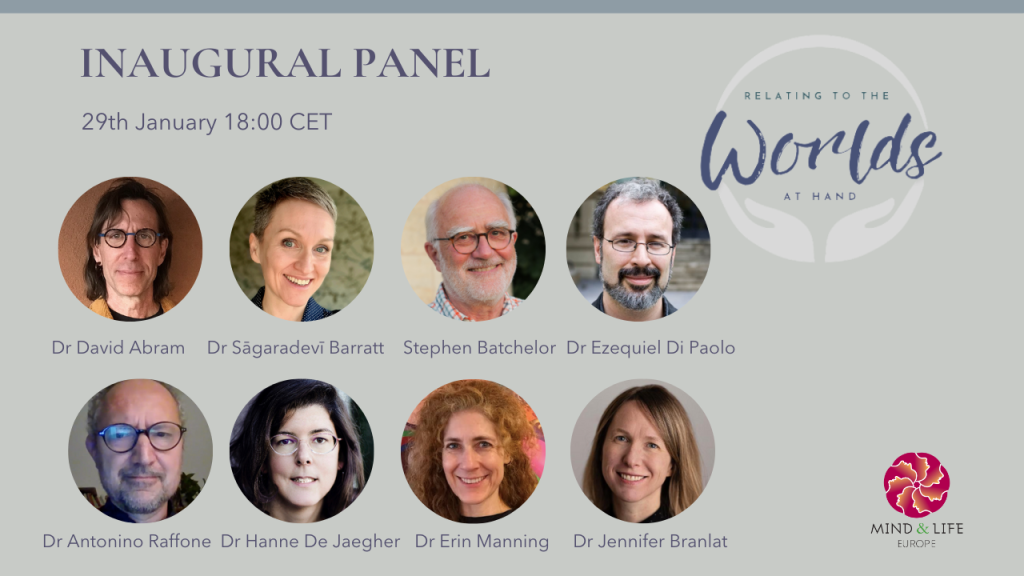
“Relating to the Worlds at Hand” Inaugural Panel 2025
Register Here!
There is good reason why one might look around and feel beleaguered and ill-equipped to
countenance the world as it appears before us. The challenges are too numerous and
fraught to name here. But let us simply consider the scale of many of the challenges before
us: if we take climate change, political polarisation, or social inequality, poverty, war, or mass
migration, the weaponisation of technology, addictive consumerism, or the spread of
misinformation, most of us would agree that none of these challenges can be solved by the
individual alone. Nor were they meant to be. For none of them are properly within reach of
the individual, at least in the way that they appear. And yet, we are still called to relate to
them in one way or another.
Being embedded and embodied beings, we need to acknowledge, on one level, the very
localised nature of our agency, and seek ways to relate to what is already ‘at hand’ in the
conventional sense. By acting from our situatedness, and working to refine our agency in
a granular way, it could be said that we are exercising the only real agency we have. Prof
Tim Lenton has spoken compellingly of the tipping points, both negative and positive, that
result from an accumulation of localised, grassroots efforts, and this is particularly true in an
age in which we are as intensely networked as we are today. Moreover, to suppose we can
abide purely in a ‘view from nowhere,’ as Thomas Nagel has suggested, strips us of the
only concrete engagement we can have with the world. The fact is, we always begin from a
situated perspective — our firsthand experience — and to deny it puts us at risk of
perpetuating erroneous assumptions.
But what if we were to nuance the above and question the very premise of a world existing
‘out there,’ as separate from the lone self ‘in here’. If we take the ‘view from within’ — an
enactive, organism-centred perspective — things begin to look quite different. For example,
we begin to see that self and world are co-constructed and co-evolving, and that even to
speak of the ‘world(s) at hand’ is somewhat of a misnomer. Because of our intimate
entanglement with the world, the world is in some sense always, already at hand, particularly if we understand the processes that make self and other possible as in-between
and all around (E. A. Di Paolo), rather than in here and out there (as Cartesian dualism
would have us suppose). In this view, acting from a situated perspective necessarily affects
a much larger field — beyond, precisely, what is perceptually ‘at hand.’
If this is the case, on what can it be said that we are acting? Where does our agency lie if we
are so inextricably bound up with the world? What would prevent us from simply resigning
ourselves to passive disengagement, precipitous relativism (“anything goes” or “everything is
equally valid”), or spiritual bypassing (“all is well” or “all is one”)? How can we live in a way
that honours the imminence of the world and our entanglement with it, while also
taking personal responsibility for effecting change in the world? Moreover, how can we
honour the plurality of the many life-worlds that are at play when we consider how to act?
Can we imagine “liv(ing) in one world that includes a multiplicity of worlds,” as Gábor Karsai
spoke of in our November 2024 MLE Community Call? Can we work from the premise of
“difference without separability” (Édouard Glissant), a vector of heterogeneity, rather than homogeneity? Is there a “lived, living logic” (Hanne De Jaegher) we can draw upon to
honour both entanglement and differentiation, immanence and otherness?
The panelist in MLE’s 2025 Inaugural Panel will be invited to reflect on these questions from their particular horizon of inquiry and life experience, seeing where they might lead the discussion — not simply as theoretical questions but as lodestars for orienting to a more awakened, equanimous, and compassionate life. Let’s reflect together on what “Relating to the Worlds at Hand” might mean for the future of our work together and for the future of life on this planet.

David Abram
David Abram – cultural ecologist and geophilosopher – is the author of The Spell of the Sensuous: Perception and Language in a More-Than-Human World, and Becoming Animal: An Earthly Cosmology. Described as "revolutionary" by the Los Angeles Times, as “daring” and “truly original” by the journal Science, David's work engages the ecological depths of experience, exploring the ways in which sensory perception, language, and imagination inform the relation between the human animal and the animate earth. David's philosophical craft is informed by his fieldwork with indigenous peoples in southeast Asia and the Americas, as well as by the philosophical tradition of phenomenology.
Dr. Abram was the first contemporary philosopher to advocate for a reappraisal of "animism" as a complexly nuanced and uniquely viable worldview, one which roots human cognition in the dynamic sentience of the body while affirming the ongoing entanglement of our bodily experience with the uncanny intelligence of other animals, each of whom encounters the same world that we perceive yet from an outrageously different angle and perspective. His work also articulates the entwinement of human subjectivity with the varied sensitivities of the plants upon whom we depend, as well as with the agency and dynamism of the particular places, or bioregions, that surround and sustain our communities. In recent years, David's work has come to be associated with a broad movement loosely termed "New Materialism," due to his espousal of a radically transformed sense of matter and materiality.
In his first book, David coined the phrase "the more-than-human world" in order to speak of nature as a realm that thoroughly includes humankind, yet also necessarily exceeds humankind; the phrase has now been taken up worldwide within the broad movement for ecological sanity. Dr. Abram has received numerous awards, including Rockefeller and Watson fellowships, and the international Lannan Literary Award for Nonfiction. Currently the Senior Visiting Scholar in Ecology and Natural Philosophy at Harvard University, David usually makes his home in the foothills of the southern Rockies, where he is co-founder and director of the Alliance for Wild Ethics (AWE).
Sāgaradevī Barratt
Sāgaradevī Barratt is a Senior Lecturer in the School of Health and Social Care at the University of Essex, Programme Lead for MSc Medical and Clinical Education, and contributor to the Professional Doctorate in Clinical Psychology programme. Since 2014 she has been interested in contemplative pedagogy and has been applying contemplative ways of teaching and learning in her practice as well as developing opportunities for other educators to develop their skills and knowledge in the field. Sāgaradevī’s recent theoretical work explores how the enactive approach and recent developments in the cognitive science of wisdom could support the development of theory in contemplative education, informing future research and deepening understanding of its potential contribution to human flourishing. Her past empirical research, using qualitative methods, has touched on a range of topics related to mental health, trauma and social marginalisation. In the future, she hopes to develop her research in education as well as exploring how the lens of enaction might contribute to research in mental health and social care. Sāgaradevī is a member of Mind and Life Europe and on the organising committee for the 2024 Mind and Life European Summer Research Institute, founding member of the Contemplative Pedagogy Network and ordained member of the Triratna Buddhist Order.
Stephen Batchelor
Stephen Batchelor is a writer, translator, teacher and artist. Born in 1953, he was ordained as a Buddhist monk at the age of twenty-one and spent ten years training in the Tibetan Geluk and Korean Son orders. Stephen has translated Shantideva’s A Guide to the Bodhisattva’s Way of Life (1979) and Nagarjuna’s Verses from the Center (2001), and is the author of Buddhism without Beliefs (1997), Living with the Devil (2004), Confession of a Buddhist Atheist (2010), After Buddhism (2015), The Art of Solitude (2020), and Buddha, Socrates, and Us (2025). He has also co-authored What is This? Ancient Questions for Modern Minds (2019), with his wife, Martine Batchelor. In 2015, he co-founded Bodhi College, a European educational project dedicated to the understanding and application of early Buddhism. He lives in south-west France with his wife Martine.
Jennifer Branlat
Jennifer Branlat is associate professor in gender equality and diversity at the Department of Interdisciplinary Studies of Culture at the Norwegian University of Science and Technology (NTNU). Jennifer is originally from the United States, holds a PhD in French Cultural Studies and worked at Antioch College before moving to Norway. She is particularly interested in pedagogy, inclusion and teaching outide the classroom. Her recent project, a collaboration with Katrin Heimann, Suneetha Saggurthi and Siri Øyslebø Sørensen, uses micro-phenomenology to understand the ways in which people experience affirmations and other micro acts of care and kindness in academic contexts.
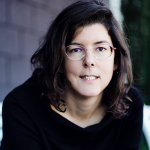
Hanne De Jaegher
Hanne De Jaegher is a philosopher and cognitive scientist. She notably developed the theory of participatory sense-making, together with Ezequiel Di Paolo. Participatory sense making theory is being used across academic and practical disciplines, from neuroscience to the arts and beyond. De Jaegher also researches and writes about autism and dementia, in close connection with people with lived experience, and innovates interactive methodologies. She thinks a lot about loving and knowing as both existential, tension-full relations, and how they can illuminate each other in philosophy, cognitive science, and our (intersubjective) lives. With Ezequiel Di Paolo and Elena Cuffari, she co-authored Linguistic Bodies: The Continuity between Life and Language (MIT Press, 2027). Currently, she is working as an in(ter)dependent scientific advisor and teacher, among other roles, for Mind & Life Europe.
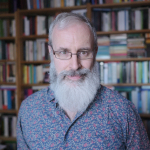
Ezequiel A. Di Paolo
Ezequiel A. Di Paolo is a Research Professor working at Ikerbasque, the Basque Science Foundation in Spain and a Visiting Professor at the Department of Informatics, University of Sussex. His interdisciplinary research on embodied and enactive approaches to life, mind, and society integrates work from cognitive science, neuroscience, phenomenology, philosophy of mind, and computational modelling. His research focus is on enactive theory, embodied intersubjectivity, language, ethics, and participatory sense-making. He is (co)author of over 200 publications, including the books Sensorimotor Life: An Enactive Proposal (2017, Oxford University Press) and Linguistic Bodies. The Continuity between Life and Language (2018, MIT Press). He is co-editor of the recently published annotated edition of Francisco Varela’s Principles of Biological Autonomy (2025, MIT Press).
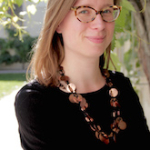
Johanna Magin
Johanna Magin is MLE's Community and Programs Manager. Originally American and based in Paris, Johanna holds a PhD in French literature from Columbia University (New York) and a BA in French from the University of Chicago. Her research has focused on the medico-philosophical practices of several early-modern French authors in an attempt to understand the relationship between mind and body, and more broadly between science and spirituality, in that time period. Always keen to understand mind-body processes from an experiential perspective, she has also practiced Buddhism intensively since 2008 (Zen and Dzogchen), practiced improvisational dance and theatre since 2009, and is currently training to become a Rosen Method bodywork therapist. Before joining MLE, she worked as an academic program manager and adjunct faculty member at Sciences Po in France, where she taught on a wide number of subjects, from philosophy as a way of life to the politics of poetry.
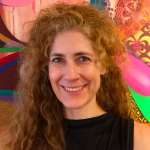
Erin Manning
Erin Manning studies in the interstices of philosophy, aesthetics and politics, concerned, always, about alter-pedagogical and alter-economic practices. Pedagogical experiments are central to her work, some of which occur at Concordia University in Montreal where she is a research chair in Speculative Pragmatism, Art and Pedagogy in the Faculty of Fine Arts. Recent monographs include The Minor Gesture (Duke 2016), For a Pragmatics of the Useless (2020) and Out of the Clear (minor compositions 2022). Her artwork is textile-based and relationally-oriented, often participatory. She is interested in the detail of material complexity, in what reveals itself to perception sideways, in the quality of a textural engagement with life. Her work often plays synesthetically with touch, of recent in acknowledgement and experimentation with the ProTactile movement for DeafBlind culture and language. Tactile propositions include large-scale hangings produced with a diversity of tools including tufting, hooking, knotting, weaving. 3e is the main direction her current research takes - an exploration of the transversality of the three ecologies, the social, the environmental and the conceptual. An iteration of 3e is a land-based project north of Montreal where living and learning is experimented. Legacies of SenseLab infuse the project, particularly the question of how collectivity is crafted in a more-than-human encounter with worlds in the making.

Antonino Raffone
Antonino Raffone completed a Master in “Psychology” and a Doctorate in “Cognitive Psychology and Science” at Sapienza University of Rome. He is currently Associate Professor at the Department of Psychology of Sapienza University of Rome (Italy), and Visiting Professor and Advisory Faculty at Nalanda University (India). He is also Director of the Interuniversity Center ECONA at Sapienza University of Rome, President of “Consciousness, Mindfulness, Compassion – CMC – International Association”, and Chief Editor of the Specialty Section on “Consciousness Research” of “Frontiers in Psychology”. His internationally recognized research is interdisciplinary, with a particular focus on cognitive neuroscience of consciousness and meditation. Finally, he is a dedicated Soto Zen practitioner.

Amy Cohen Varela
Amy Cohen Varela is Chairperson of the Mind & Life Europe Board and involved with Mind and Life since its inception. She is also a clinical psychologist specialized in psychodynamic therapy and philosophy. Amy studied comparative literature at Brown and Columbia Universities before moving to Paris in the early '80s, where she received her degree in clinical psychology at the University of Paris 7, with a specialty in psychodynamic theory and practice, and in parallel, completed psychoanalytic training.
Event info
“Relating to the Worlds at Hand” Inaugural Panel 2025
Date
29-01-2025 06:00 PM
29-01-2025 08:00 PM
29-01-2025 08:00 PM
Location
Online